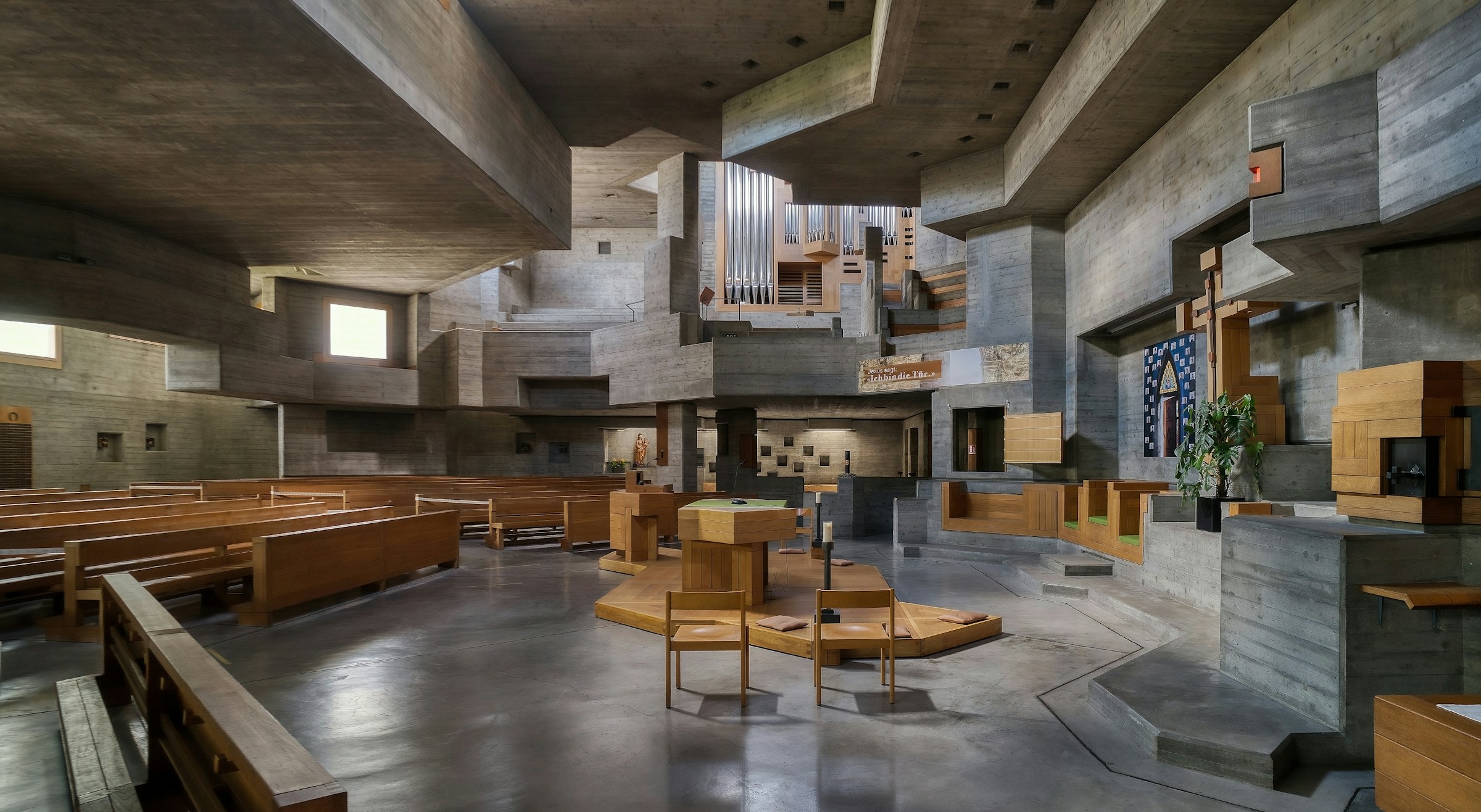
For any cinema lovers, it will have been impossible to welcome in the new year without catching wind of Adrian Brody’s latest big screen endeavour, The Brutalist. Starring as tortured architect Lazlo Toth, Brody brings to life the dazzling thrill and simultaneous horror of the immigrant experience- but one of the key figures of the film, is Lazlo’s work itself.
Although Lazlo Toth is in fact a fictional character, his life is a blend of a few very real notable individuals, – including Marcel Breur, who’s work contributed heavily to the definition of Brutalism as we know it today. Breur ’s controversial architectural habits served as the inspiration for Brody’s characters monolithic creations- and if the motion picture captured your attention and imagination, we’re going to run through exactly who was Marcel Breur, and how you can incorporate a bite-sized portion of his divisive style into your home.
Who was Marcel Breur?
Like Brody’s character, Marcel Breur was a Hungarian-Jewish immigrant, although his story is less rags to riches, and (presumably) less traumatising than that depicted in the film. Marcel first began to attract notoriety for his work because of his bicycle-inspired pieces of steel furniture, developing tables and chairs that may have looked more at home in an oddly aesthetically pleasing scrapyard, rather than a furniture showroom. However, Breur’s divisive work continued to grow in esteem, and throughout his life his distinctive style would find itself manifest in increasingly grand forms.
Breur designed several large-scale buildings throughout his time, ranging from flat blocks to institutional buildings such as the US Department of Housing and Urban Development, which was once described as “10 floors of basement”. In The Brutalist, Toth finds himself treading the line of visionary and madman most precariously whilst working on a monolithic church design, looming ominously on a hilltop overlooking a nearby American town. This scenario is in fact inspired by Breur’s Saint John’s Abbey, which can be found in Minnesota, and is an equally imposing sight. The Church bears all of the hallmarks of Breur’s brutalist flair, with a large looming shape that claws it’s way into the sky, a titan draped in Grey.

What is Brutalism?
Brutalism is an architectural style, that all above all else favours utility over aesthetics. Many consider Brutalist architecture to be unappealing and aggressive, and in instances throughout history brutalist architecture has been met with protest, demanding the destruction of such buildings. The style favours bare building materials such as unpainted concrete or rock, and harsh, geometric shapes that greet those around it with hostility. The style has been favoured by socialist and communist nations throughout history, it’s raw materials and uncompromising aesthetic standing in harsh contrast to the traditional styles of the Bourgeoisie.
Although often met with controversy, for those with an eye for the uncanny brutalism provides what many other architectural styles cannot. There is good reason for the styles patron’s being held in such high esteem- in today’s world, non-conformity is rare, and to see a large-scale brutalist design amongst a surrounding of more traditional forms is a sight to behold. To quote Adrian Brody’s mythical architect, “A rock does not change, or accommodate for those around it, it simply is”, a methodology that many find endearing when it comes to this style of architecture.
How to incorporate it into your home
Although channelling the grand behemoths of Breur’s life’s work may seem an impossible task, the ideas that bring Brutalism to life have found root in interior design as much as architecture. As with any style of expression, Brutalism is less about a set of fixed ingredients, but a way of thinking that can be adopted on any scale.
Brutalism in interior design shares many traits with minimalism- embracing open space and monotone colour schemes, very much adopting a mindset of less is more. Like minimalism, brutalism in interior design looks to use these open spaces as defining characteristics of the interior space- embracing these voids rather than trying to fill them.
However, Brutalism will also look to accentuate the industrial tones that permeate that of the architectural discipline. Whilst minimalism would favour white or black colour schemes to create it’s iconic style, brutalism would make use of more earthy, or metallic tones. Colour schemes utilising grey, brown and black colours will channel the industrial angst needed to truly embody the style.
For inspiration with furniture, look at some of Breur’s earlier works- cast-iron chairs with skeletal frames, sleek and streamlined, with no more components than strictly necessary. When looking at decorations, statues and ornaments that look distinctly rustic or metallic in tone would embody the brutalist style, preferably metal or stone, with unaccommodating shapes and aesthetics. However, any decorative items should be used sparingly- the lack of competing features will lend strength to those present, standing alone and unapologetic, much like Breur’s buildings.

Lighting must also be considered, to avoid any brutalist spaces becoming dark and claustrophobic. Natural light should be welcomed during the day, if possible make use of large windows to allow sunlight to fill the room as much as possible and illuminate the main features on display. This use of natural light is in keeping with the brutalist style, making use of natural elements whilst still making sure to balance out the style’s sometimes sombre colour scheme. For evenings, an ideal lighting choice would be a wood fire, but failing that, try and create a warm, natural feeling light source rather than anything too white and synthetic, with any lamps or chandeliers in keeping with the bare bones and industrial style.
Whilst divisive, Brutalism is a style that can be sure to turn heads and linger in memory. On paper, the style looks to challenge the viewer, uncompromising in it’s form, but for a certain few this is the beauty of the style. One thing that’s for certain, is no one ever found their life’s work interpreted by a chain-smoking Adrien Brody by trying to be a crowd pleaser.